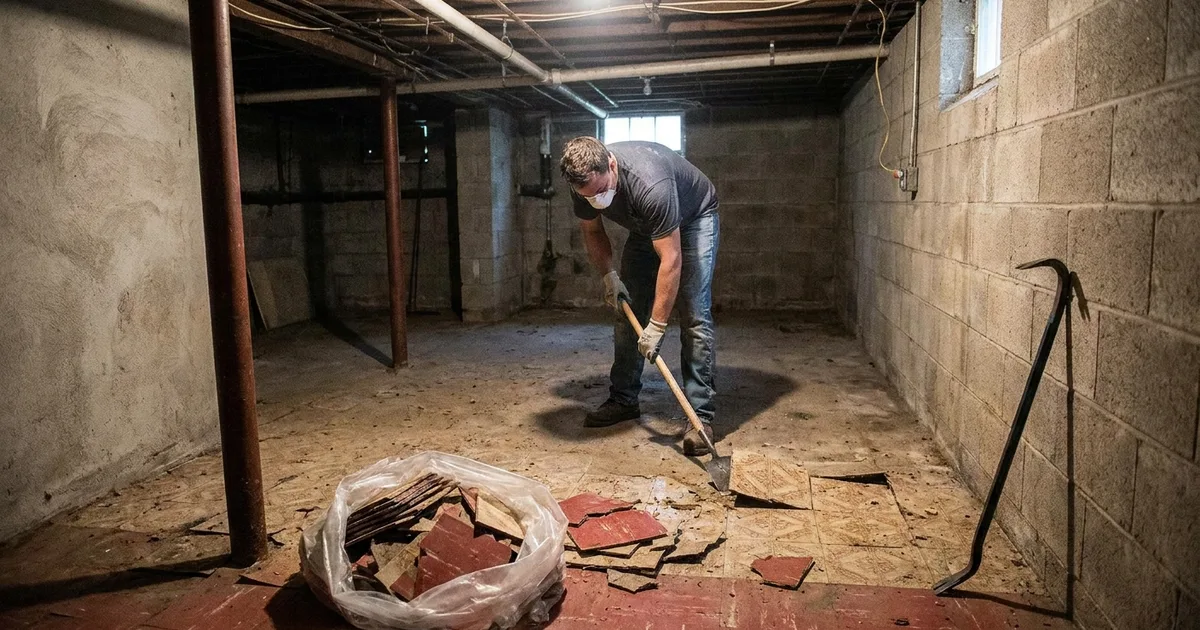
You pulled up the carpet and found square tile underneath. Probably tan, maybe with a faint marbled pattern, and about nine inches on each side. Your first thought, that this might be asbestos floor tile, was right to be suspicious. Your second thought, to panic and start pricing removal crews, is the one that costs people money they did not need to spend.
Old 9x9 tile is the classic asbestos red flag, and the instinct behind that is sound. But with asbestos floor tiles the size is a clue, not a verdict. Two tiles can look identical while only one contains asbestos, so looking at it can raise your suspicion and nothing more. The next move matters far more than the tile itself.
Here is the honest version of what happens next, in the order that actually saves you money: identify what you are looking at, confirm it with a cheap lab test, decide whether it even needs to come up, and only then price out removal. For a lot of homeowners the answer at step three is “do nothing,” and getting to that answer before you call anyone is the whole point.
Short answer: Old 9x9 resilient tile has a high chance of containing asbestos, but you cannot confirm it by sight. A mail-in PLM lab test, typically well under $100, settles the question before you spend anything on a contractor. Intact tile sitting under your feet is low-risk, so removal is a renovation decision, not an automatic requirement.
Why 9x9 Tiles Are the Asbestos Red Flag (And Where the Rule Breaks Down)
The 9x9 rule exists for a real reason. Nine-inch vinyl composition tile was the dominant format manufactured during the asbestos-tile era, roughly 1952 through 1986. It was cheap, durable, and installed by the millions in basements, kitchens, and bathrooms. When a size shows up that consistently across decades of asbestos-loaded flooring, it becomes shorthand, and that is how “9x9 equals asbestos” entered the homeowner vocabulary.
The odds behind the rule are genuinely high. Some estimates put the chance that a 9x9 resilient tile contains asbestos above 90 percent, and one source cites roughly 99 percent for tiles made before the late 1990s. So when your instinct flagged that square tile, the instinct was working with good data.
Here is where the version of the rule that ranks online breaks down. The 9-inch size is not the only asbestos size. Twelve-inch and eighteen-inch squares were also produced with asbestos, so the safer read is “old square resilient tile in a pre-1980s home” rather than “only 9x9 is a problem.” If you rule out asbestos just because your tiles measure a foot across, you can rule out wrong.
This keeps surfacing because of the age of the housing stock. Roughly half of all US homes were built before 1980, per the Census Bureau’s 2019 American Community Survey. That is why old tile turns up decades later during a basement finish or a kitchen remodel, often hidden under carpet, sheet vinyl, or a newer tile layer someone installed straight over the top.
What size cannot do is prove anything. The only wrong-safe move is to treat any pre-1980s resilient tile as asbestos until a test says otherwise, which makes the next question what you can actually see.
What Asbestos Floor Tile Actually Looks Like
There is a fairly specific look to vinyl asbestos tile, and knowing it lets you move the odds before you spend a dollar. Solid beige, tan, or cream is the most common. So is dark brown or maroon with subtle marbling, gray with faint streaking, or solid green, blue, and terra cotta, often shot through with a speckled or flecked pattern. A pre-1980s tile in one of these color families earns a much closer look, even though the color alone still proves nothing.
There are physical tells beyond color. An oily or stained surface texture is one. The other sits underneath the tile: a black, tar-like adhesive residue visible at the seams or where a tile has lifted. That black material is called cutback adhesive, and it is worth naming as its own thing rather than treating it as a tile feature.
Cutback adhesive was used to glue these tiles down from the 1950s into the early 1980s, and it frequently contains asbestos in its own right, sometimes at a higher percentage than the tile above it. That single fact shapes both how you test and what removal ends up costing, which is why it comes up again in both of the sections below.
Two tiles can look identical while only one contains asbestos, which is the honest limit of any visual check. Looks narrow the odds; they never close the case. For a broader tour of what these materials look like beyond flooring, our guide to what asbestos looks like covers the other common household materials.
How to Actually Confirm It (Testing, Not Guessing)
There is exactly one method that confirms asbestos content in floor tile: polarized light microscopy, or PLM, run on a physical sample in an accredited lab. That is the flat answer to “how do I know for sure.” No visual guide, no build-year table, and no forum thread substitutes for it. Everything before this section moves the odds. This is the step that ends the guessing.
Sample the tile and the adhesive separately. The black cutback adhesive underneath is often a higher percentage of asbestos than the tile itself, so a tile-only test can come back clean while the glue is the real problem. Two samples, tested as two materials, is the difference between a complete answer and a misleading one, and it is the step most homeowners and even some quick inspections skip.
Sampling itself is tactical, not complicated. A small chip taken from an inconspicuous spot, or better, a sample pulled by a professional, double-bagged and sent to the lab, is the whole job. This guide is not going to teach deep DIY sampling, because in several states that work is regulated and because a licensed inspector removes the guesswork entirely. If you want the full process, our dedicated asbestos testing guide walks through sampling and lab steps in detail, and you can find a local firm through our asbestos testing directory.
Weigh the price against the alternative. A mail-in PLM test, typically well under $100, is trivial next to the anxiety spiral it ends and the removal quote it might make unnecessary. Testing first is what stops a suspected-asbestos situation from turning into a removal job by default. And a “yes” from the lab still does not mean you call a crew tomorrow.
You Found Asbestos Tile. Now What? (Leave It, Cover It, or Remove It)
Start with the fact that reframes everything: intact, undisturbed asbestos tile is low-risk. The fibers are bound into the material, not floating in your air. Risk appears when the material is damaged or disturbed, when someone sands it, drills through it, or pries it up without controls. Passive presence under your feet is not the hazard. Disturbance is.
That is why a positive test opens three legitimate options rather than one, each right in different conditions.
- Leave it alone. The safest and cheapest option when the tile is intact and no renovation is forcing your hand. If it is in good shape and you are not tearing up that floor, doing nothing is a real answer, not a cop-out.
- Encapsulate or cover it. Seal the tile with a coating, or install new flooring straight over it, such as vinyl plank, laminate, engineered hardwood, or new tile, sometimes over a plywood or cement board underlayment first. This locks the fibers in without a full abatement job and is one of the most cost-effective ways to manage asbestos tile.
- Remove it. The right call when the tile is already damaged, when a renovation requires it to come up, or when a sale or inspection forces clearance. This is the option that brings in licensed abatement and real cost.
The stakes behind the “don’t disturb it” guidance are worth stating plainly, once. Inhaled asbestos fibers are linked to asbestosis, mesothelioma, and lung cancer, all long-latency diseases, which is exactly why the caution exists even though the tile is not dangerous just sitting there. Peer-reviewed exposure modeling of vinyl-asbestos floors points the same way: it is damage and disturbance, not passive presence, that puts fibers into the air you breathe.
So do not let anyone convince you that a positive test automatically means demolition. Removal is a renovation decision, not an automatic requirement. If the floor is intact and staying put, the smartest and cheapest move is often to leave it or cover it and get on with your life. For anyone who does land on removal, here is what that actually costs and why the price swings so much.
Asbestos Floor Tile Removal Cost (What Drives the Price)
The headline number for professional asbestos floor tile removal is $5 to $15 per square foot. The national average total project cost lands around $3,250, inside a broader range of $1,500 to $5,000 and up depending on scope. Those are the figures to hold in your head when a contractor quote arrives, so you can tell a fair number from a padded one.
To map that to your own space, picture a 300 square foot basement, a common asbestos-tile scenario. That job runs roughly $2,500 to $5,000. If your room is bigger, the per-square-foot rate is what scales the total, which is why area is the first thing any honest estimator asks about.
The range is wide because a handful of specific drivers move the price, and understanding them is how you read a quote instead of just flinching at it:
- Total area. The base multiplier. More square footage, more abatement, more disposal.
- Multiple tile layers. When old tile was covered with newer tile instead of being removed first, a crew has to deal with both, which stacks labor and material.
- The black cutback adhesive. The same glue from the identification section. It is frequently the hardest and most expensive part of the job to fully remove, and it is usually what pushes a quote past the low end of the range, not the visible tile.
- Permits and disposal. Local permit and inspection fees, plus hazardous-waste disposal at a licensed facility. Asbestos debris cannot go in regular trash, and that fee is not optional.
Homeowners assume the tile is the expensive part. In practice the stubborn black adhesive underneath is what turns a low-end estimate into a high-end one. If a quote seems high for the visible floor area, the adhesive is usually why.
One sourcing note worth being straight about: the “presume it is asbestos” cutoffs you will see quoted, such as pre-1980 or pre-1981, are commonly attributed to EPA and OSHA policy by industry sources rather than lifted from a single primary-source page. Treat them as the well-established rule of thumb they are, and let the lab test, not the date, make the final call. Whatever the number comes out to, it only holds up if a properly licensed person does the work, which most states require by law.
Why You Need a Licensed Contractor (And How to Find One)
Most states require asbestos abatement to be performed by a licensed contractor. This is not optional paperwork. It is the law across the large majority of states, and it is also your protection. Unlicensed removal, done without containment or proper controls, is precisely what turns a low-risk intact floor into an airborne-fiber problem in your home.
The catch is that licensing is run state by state, with no single national register. Verifying that a contractor actually holds a current asbestos license is harder than it should be, because you have to know which state agency to check and where its list lives. Marketplaces like Angi and Yelp do not close that gap. They take listings and show star ratings, but they do not verify whether a firm holds an asbestos license at all. A five-star review is not a license.
That gap is the whole reason The Asbestos Register exists. Every firm listed is cross-checked against its issuing state’s official licensing register before it goes live, with the license number and agency shown alongside it. You do not have to figure out which state .gov PDF to dig through. In New York, for example, verified listings show you at a glance who is actually cleared to do the work, and you can search the same way for asbestos removal near you in any covered state.
So the sequence is short. The size of your tile sets the odds, a lab test settles them for the price of a nice dinner, and a positive result gives you three paths, not the single expensive one most quotes assume. Finding the tile was never the emergency. Guessing about it, and hiring the wrong person to touch it, is the only part that actually hurts you.