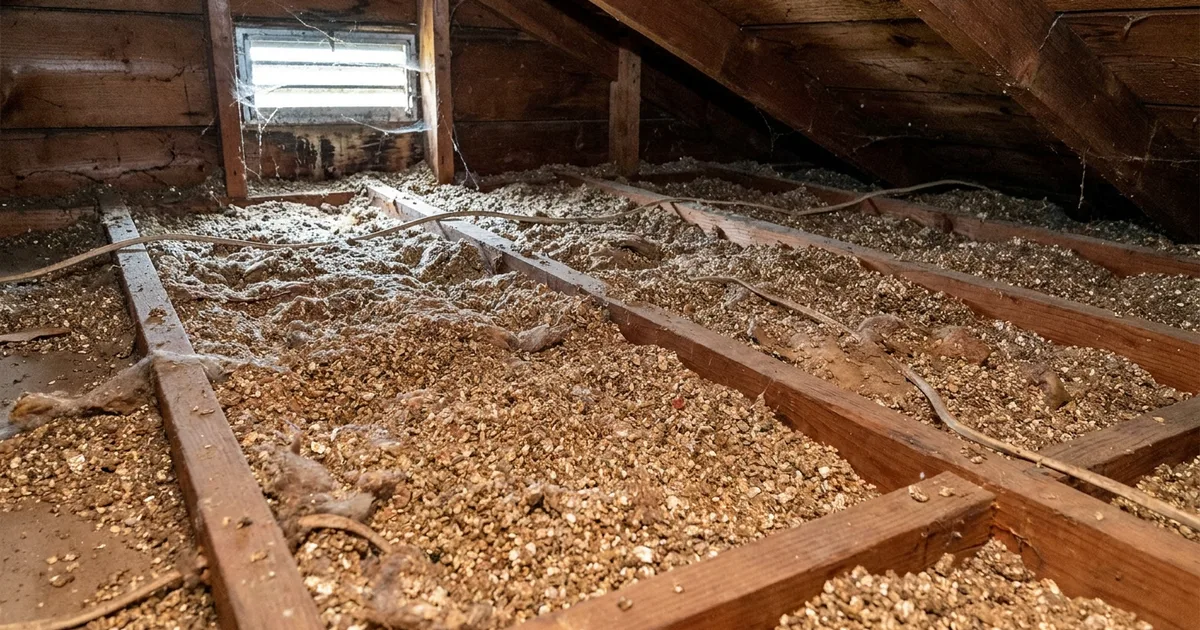
If you just climbed into your attic and found small, shiny gold-brown pebbles instead of the pink fluff you expected, or you are staring at chalky white wrap around a basement pipe, you are not looking for a lawsuit. You are looking for an answer. Most of what ranks for “asbestos insulation” gives you one or the other.
Asbestos insulation is not one material. It is three, and they look nothing alike. Pipe lagging is chalky wrap on your heating pipes. Loose-fill vermiculite is the sparkly pebble stuff in the attic. Block and spray insulation is solid slabs or a rough sprayed-on coating. Each has a different look and a different risk, and every guide that lumps them together is why you are confused right now.
This guide names which of the three you are probably looking at, tells the real Zonolite story with EPA sourcing rather than scare copy, gives honest 2026 cost ranges, and ends with a concrete next step. If your home was built before 1980, the rule is simple. Do not guess, and do not panic. Identify the type, leave it alone if it is undisturbed, and get it tested before you touch it.
Short answer: Asbestos insulation comes in three forms with different looks: chalky pipe lagging, shiny pebble-like vermiculite attic fill, and solid block or sprayed coatings. You cannot confirm any of them by sight. Undisturbed material in good condition is low-risk, so the safe move is to leave it alone and get a sample tested before any work that would disturb it.
What Asbestos Insulation Actually Is (and Why It's Still Around)
Asbestos insulation ended up in millions of American homes for three plain reasons: it resisted fire, it insulated well, and it was cheap. It was used extensively from the 1930s through 1980, with peak use between 1940 and 1980. US asbestos consumption itself peaked in 1973.
The regulation that followed came in stages, not as a single ban, which is why so many homeowners assume asbestos was outlawed decades ago and are surprised to find it in their own attic. The EPA banned spray-applied asbestos fireproofing and insulation in 1973, banned new installation of friable pipe and block insulation in 1975, and closed the remaining spray-applied use in 1978.
A sweeping 1989 EPA rule that tried to ban most asbestos products never held. The Fifth Circuit Court of Appeals vacated it in 1991, which means asbestos was never comprehensively banned in the US. It remains legal in limited uses to this day, with the EPA's chrysotile-specific ban in March 2024 being the most recent major action.
The practical point matters more than the dates. None of those bans required anyone to remove material already installed. It is perfectly legal for original asbestos insulation to sit in a pre-1980 home indefinitely, as long as it stays undisturbed. That is why this is a present-day question and not a history lesson, and it is why the next thing to get right is what the material actually looks like.
The Three Types of Asbestos Insulation, and How to Tell Them Apart
What does asbestos insulation look like? It depends which of the three you have. That is the trap in most guides: they give one blurry description when the thing in front of you is one of three genuinely different materials. Knowing which one you are looking at is the difference between calm and panic, so treat these as three separate things.
Pipe and boiler lagging
Pipe lagging shows up as chalky white or gray corrugated wrap, often hidden under a paper or canvas outer layer, and it feels brittle or chalky if you touch it. You find it on hot water and steam pipes, boilers, and tanks. This is the type most often disturbed during plumbing or HVAC work, which is exactly the moment it becomes dangerous. If a plumber is about to cut into a wrapped old pipe, stop and identify what the wrap is first.
Loose-fill attic insulation (vermiculite / Zonolite)
This is the one that sends people to Google in a slight panic. Loose-fill vermiculite looks like small, shiny gold-brown or gray pebble-like pieces with a layered, accordion-like structure that catches light and looks a little sparkly from different angles. It is visually distinct from modern fiberglass batts or cellulose fill, so if you are wondering “is my attic insulation asbestos,” the pebble look is the first tell. This type gets its own section below, because there is a specific contamination story behind it that changes how you should think about your attic.
Block, slab, and spray-applied insulation
Block and slab insulation appears as solid white or gray slabs glued or fastened to walls and tank surfaces. Unlike the crumbly pipe wrap, these slabs are rigid and hold their shape, which is why they are easy to mistake for ordinary building board. Spray-applied insulation is different again: a rough, fibrous, sometimes cottage-cheese-like texture on structural beams or ceilings. General loose or blown-in asbestos insulation outside the vermiculite category can also look fluffy or powdery in white, gray, or light brown tones.
One blunt rule closes this section. If you are not sure which of the three you are looking at, treat it as asbestos until a test says otherwise. Visual identification narrows the odds. It never rules it out.
Why Vermiculite (Zonolite) Attic Insulation Gets Special Attention
Vermiculite gets flagged separately for a documented reason, not because it is automatically the worst. Over 70% of all vermiculite sold in the US between 1919 and 1990 came from a single mine near Libby, Montana, and the ore from that mine was contaminated with asbestos.
Because Zonolite was the dominant brand of vermiculite loose-fill insulation, the reach is enormous. The EPA estimates that as many as 30 million US homes may still have Zonolite in their attics today. Read that figure carefully. It is specific to vermiculite and Zonolite attic insulation, not to asbestos insulation in general, so do not let it inflate your sense of risk for a pipe wrap or a wall slab.
The EPA's own guidance for homeowners who find vermiculite is concrete. Do not disturb it, and do not enter the attic space unnecessarily, because disturbance rather than mere presence is what puts fibers in the air. If your vermiculite is sitting quietly under the attic floorboards and you have no reason to be up there, the safest thing you can do is nothing.
None of this means your attic is contaminated. Not all vermiculite came from Libby, and plenty of it contains no asbestos at all. The catch is that you cannot tell the safe from the contaminated by looking, because the pebbles are identical either way. That is exactly why this is the one type where testing earns its cost. The EPA's own homeowner guidance on its vermiculite attic page says the same thing.
Is It Actually Dangerous? The Friability Rule
Two facts have to sit side by side here. There is no known safe level of asbestos exposure, and the related diseases, asbestosis, lung cancer, and mesothelioma, can take decades to appear after exposure. That is worth stating plainly, once, so you take the material seriously.
The determining factor is friability, meaning whether the material crumbles, flakes, or releases dust when disturbed. It is not simply whether asbestos is present. Intact, undisturbed material in good condition is considered lower-risk than damaged or disturbed material. The danger comes from disturbance, not from presence, and that single rule carries most of the decisions below.
That rule points straight at a short list of things not to do. If you have asbestos insulation, or you suspect you do:
- Do not disturb it. Leave undamaged material where it sits rather than poking, moving, or “just checking” it.
- Do not vacuum it. A standard household vacuum exhausts fine particles straight back into the air you breathe.
- Do not cut, drill, or sand it. Any action that grinds or breaks the material is what releases fibers.
- Do not sweep or dry-dust it. Dry cleanup lifts the exact particles you are trying to avoid.
So the material sitting undisturbed in your attic or basement is not an emergency. At some point, though, you will want a real answer, whether that is before a renovation or just for your own peace of mind. Here is what that actually costs in 2026.
What Testing and Removal of Asbestos Insulation Actually Cost in 2026
A full asbestos removal job averages $2,244, with a typical range of $460 to $6,100 depending on scope, accessibility, and any repairs the work forces. That spread is wide because a cramped attic and a straightforward basement pipe are not the same job.
Pipe insulation removal has its own math. It runs $3 to $15 per linear foot, which splits roughly into $2 to $5 per linear foot for the wrap itself and $5 to $15 per square foot for the surrounding insulation. If you are pricing a stretch of wrapped basement pipe, that per-foot figure is what to hold in your head.
Disposal is not optional and not a DIY corner you can cut. Asbestos waste goes to EPA-approved facilities only, double-bagged and hauled by licensed transporters, which adds $10 to $50 per cubic yard plus a $50 to $100 permit fee. Those costs are baked into any legitimate quote.
Compliance sits behind all of it. Under EPA NESHAP rules, any renovation or demolition expected to disturb asbestos-containing material legally requires abatement by a certified contractor before the work starts. That is a requirement, not a safety suggestion, and it is the real reason DIY removal is a bad idea even where it is not explicitly illegal.
Weigh all of that against the cheaper first step most people actually need. Testing a sample, rather than removing anything, is usually far less expensive and is what tells you whether you have a problem at all. A great many homeowners test, learn the material is intact and undisturbed, and decide the right move is to leave it in place. Testing first is what stops a suspicion from turning into a removal bill by default.
How to Find a Contractor You Can Actually Trust
Once you know roughly what you have and what it might cost, the only decision left is who does the work, and this is where most homeowners get steered wrong. Generic home-services marketplaces surface contractors by ad spend or lead-gen agreements, not by verified state licensing. For a hazardous-material job, that is the wrong filter entirely.
The reason those directories can list almost anyone is structural. Asbestos abatement licensing in the US is issued and tracked at the state level, and there is no single national register. A marketplace that does not check the issuing state's list has no real way to confirm a firm holds a current asbestos license at all. A star rating is not a license.
That gap is the entire reason The Asbestos Register exists. Every listed contractor is cross-checked against its state's official licensing register before it appears, with the license number and agency shown alongside it. You do not have to work out which state .gov PDF to dig through. That is a concrete difference, not a vague trust claim.
So the practical sequence is short. Do not disturb what you found, get a sample tested first if you are unsure, and once you know you need abatement, look for a firm whose license you can actually see rather than clicking the first ad that appears. You can find asbestos removal near you the same way in any covered state.
Carry one rule out of here: the danger is disturbance, not presence. Finding old insulation was never the emergency. Guessing about it, or letting the wrong person cut into it, is. Identify the type, leave it undisturbed, and test before anything touches it. If a test confirms asbestos and the material has to come out, that is the one moment to be sure your contractor is genuinely licensed for the job.