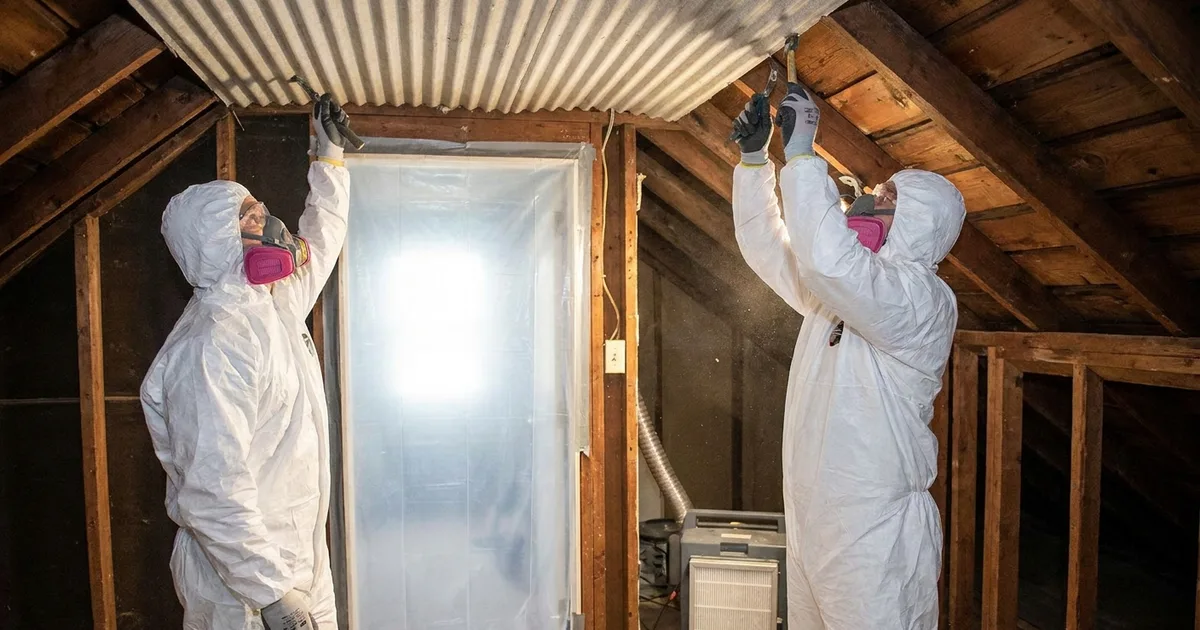
Get three asbestos removal quotes for the same job and you will likely see three very different numbers, sometimes a $2,000 spread on a single bathroom. Asbestos removal cost swings that wildly for a reason, and it is rarely the reason you would guess. This is not one contractor gouging you. In a lot of cases it is the opposite: the cheapest number came from someone who is not licensed to do the work at all.
What actually moves the price is the material and the size of the project, far more than who you happen to call first. Popcorn ceiling, siding, floor tile, and pipe insulation each carry their own price per square foot, and a single room lands nowhere near what a whole house costs. This guide breaks all of that down with real 2026 US figures so you can sanity-check a quote instead of guessing.
It also does the one thing the big cost-aggregator sites skip: it tells you how to read a quote and know whether it is legitimate before you hand over a deposit. The lowest number in your inbox is very often the one from a crew that is not licensed to do the work, and an unlicensed removal is a legal and health liability, not a bargain.
Short answer: Asbestos removal costs roughly $1,200 to $30,000+ depending on material and scope. Interior work runs $5 to $20 per square foot, exterior siding and roofing $50 to $150. A single room lands around $1,500 to $3,000, a whole house $5,700 and up. The number on the quote matters less than whether the contractor holds a current state license.
Average Asbestos Removal Cost in the US (2026)
The national average asbestos removal project costs about $2,244, with most jobs falling between $460 and $6,100. A typical contained single-area job, the kind most homeowners are pricing, runs $1,214 to $3,278. Those are the numbers to hold in your head before any quote arrives.
Be clear about where these figures come from. No federal agency publishes asbestos price benchmarks. Every number in this guide, and on every competing cost page, is drawn from contractor-survey and industry cost-guide data, not a government source. Anyone implying otherwise is dressing up an estimate as an official rate. We would rather you know the difference.
The average is useful as a floor, not a forecast. What actually moves your number is the material you are dealing with and the square footage involved, far more than which company answers the phone. The same friable-insulation job costs several times what a same-size popcorn ceiling does, whether you are in California, New York, or anywhere else. The rest of this post is that breakdown.
Asbestos Removal Cost Per Square Foot: Interior vs. Exterior
The clearest way to orient yourself is the split between interior and exterior work, because the gap is enormous. Interior asbestos removal runs $5 to $20 per square foot. Exterior removal, meaning roofing and siding, runs $50 to $150 per square foot. That is not a typo. Outside work can cost ten times more per square foot than inside work.
The reasons are physical. Exterior jobs need scaffolding and access equipment, they are exposed to weather, they generate far larger disposal volumes, and they very often bundle full replacement of the material into the same job. You are not just paying to take old siding off, you are paying to put new siding on. Interior work varies within its own range too, with wall and drywall removal landing around $8 to $13.50 per square foot.
The part that catches most homeowners off guard is where the money actually goes. Setting up containment, sealing the work area, establishing negative air pressure, and running HEPA filtration accounts for 60 to 70 percent of the total project cost. The actual removal of asbestos-containing material is the smaller share. That fixed containment cost does not shrink when the room does.
So a small job in a hard-to-reach space, a crawl space or a tight mechanical room, can cost nearly as much per square foot as a much bigger job in an open room. You are paying to build the same sealed bubble either way. Keep that in mind before you assume a tiny job should be cheap, or that a large one is being padded.
Asbestos Removal Cost by Material (Popcorn Ceiling, Siding, Tile, Pipe, Attic Insulation)
Most people searching removal cost already know their material. They have a popcorn ceiling, or asbestos siding, or old floor tile they want gone. Here is what each one actually runs, with a real-world total where the data supports one.
| Material | Typical cost | Notes |
|---|---|---|
| Popcorn ceiling | $3 to $8 per sq ft (some sources up to $20) | 1,000 sq ft home: $3,000 to $8,000 |
| Floor tile (vinyl/resilient) | $5 to $12 per sq ft (up to $15) | Mid-range for a 300 sq ft basement |
| Attic insulation | $11 to $25 per sq ft | Higher friable-risk category |
| Siding (exterior) | $50 to $150 per sq ft | Often bundles new siding install |
| Roof | $50 to $120 per sq ft | Plus new roof install on top |
| Pipe insulation | $3 to $15 per linear ft | $35 to $100 per linear ft for large or hard-to-access runs |
Popcorn ceiling is the most-searched of the group and one of the cheaper materials to handle, at $3 to $8 per square foot from most cost guides. A whole-home 1,000 square foot job lands at $3,000 to $8,000. Some sources push the high end toward $20 per square foot, which brings us to a caveat worth stating plainly.
Sources disagree, sometimes by a wide margin. Popcorn ceiling shows up as $3 to $8 on one guide and $9 to $20 on another. That is not one of them being wrong. It reflects contractor-quote samples from different regions and different sample sizes. Anyone presenting a single false-precise figure is hiding that spread from you. Treat every number here as a range and expect your own market to sit somewhere inside it.
Siding and roofing look dramatically more expensive because they usually are not just removal jobs. A siding job at $50 to $150 per square foot, or a roof at $50 to $120, typically bundles re-installation of new material into the same contract. You are seeing a removal-plus-replacement number, not a like-for-like comparison against a popcorn ceiling. Attic insulation at $11 to $25 per square foot sits high for a different reason: loose-fill insulation is frequently friable, meaning it crumbles and releases fibers easily, so it demands more careful handling.
Pipe insulation is priced by the linear foot rather than square foot, at $3 to $15 for accessible runs. Large systems or pipes tucked into tight, hard-to-reach spaces climb to $35 to $100 per linear foot, the same access-and-containment premium that drives up every awkward job.
Single Room vs. Whole-House Asbestos Removal Cost
Material tells you cost per square foot. Project size tells you the total bill, and the jump from one room to a whole house is bigger than most homeowners expect.
A single-room asbestos removal project generally runs $1,500 to $3,000. A specific 200 square foot room can land anywhere from $1,100 to $4,200, depending on the material and how accessible it is. Whole-house projects start around $5,700 and climb to $15,000 to $30,000 and beyond for whole-home friable insulation work, which is the single highest-cost category in residential abatement.
Notice what does not happen: a whole house is not simply a single room multiplied by the number of rooms. Remember that containment is 60 to 70 percent of any job. On a whole-house project, you build that expensive sealed environment once and abate multiple areas inside it, so the effective per-room cost drops through economies of scale. That is genuinely useful when you plan. If you have asbestos in three rooms and a renovation is coming anyway, doing them together is usually cheaper per room than picking them off one at a time.
What's Actually Included in an Asbestos Removal Quote
None of the numbers above include everything you will actually be billed for. A legitimate quote has several line items beyond removal, and the one homeowners get blindsided by comes first.
Testing and inspection: $250 to $850. This is billed separately from removal in nearly every case, because you cannot price removal until a lab confirms what you have. On our own site, "asbestos testing near me" pulls 3,400 searches a month against 1,000 for "asbestos removal near me". Testing is usually step one, yet plenty of homeowners search removal cost before they have even confirmed asbestos is present. If that is you, start with an asbestos testing firm before you price a single removal crew.
Disposal permits: $50 to $100, rising to $100 to $300 in some jurisdictions. Asbestos waste is regulated, and the permit to move it is not optional.
Hazardous waste disposal: $10 to $50 per cubic yard, or a flat $200 to $500 per job. Asbestos debris cannot go in regular trash. It goes to a licensed facility, and you pay for the distance and the handling.
Post-abatement air clearance testing. This confirms the air is safe to breathe before anyone reoccupies the space, and it is increasingly mandatory rather than optional. In some markets it now adds noticeably to the bill, which is a good reason to see it itemised rather than assumed.
So when you compare quotes, watch for what is missing. A number that leaves out testing, permits, or air clearance as separate line items is not the cheaper option, it is the incomplete one. A quote that looks suspiciously clean usually got that way because something required was left off it.
Encapsulation vs. Removal: The Cheaper Option (and When It Doesn't Apply)
There is one variable that can change your math entirely: whether you need full removal at all. Encapsulation, sealing the asbestos-containing material in place rather than tearing it out, runs $2 to $6 per square foot. Against removal at $5 to $20 and up, that is roughly 30 to 50 percent cheaper.
Encapsulation is appropriate when the material is in good condition and will not be disturbed by a renovation or demolition. Intact asbestos siding that is staying put, or sound pipe insulation nobody is going to touch, are exactly the cases where sealing beats ripping out. You lock the fibers in, you spend a fraction of the money, and you move on.
It is the wrong call when the material is already in poor condition, or when the area is about to be renovated or demolished. Encapsulation does not eliminate the asbestos. It seals it. That makes it a stopgap, not a permanent fix, and it is useless on material a renovation is going to disturb anyway.
Do not let a contractor sell you encapsulation as a permanent solution on material that is already damaged. Sealing crumbling asbestos does not fix the problem, it hides it, and it leaves the real hazard sitting in your walls for the next owner to inherit.
Why the Cheapest Quote Is Often the Most Expensive One You'll Ever Get
Whichever option you choose, one factor in every quote matters more than the price itself: who is actually doing the work. This is the part the aggregator cost pages never tell you, and it is the reason our directory exists.
Federal law requires trained, certified contractors for asbestos abatement. EPA NESHAP regulations and OSHA worker-safety rules together demand full containment, continuous air monitoring, disposal at regulated facilities, and post-clearance testing before an area is reoccupied. That compliance is most of what you are paying for, and it is exactly what an unlicensed crew skips to undercut everyone else. You can read the requirements straight from the source on the EPA's asbestos NESHAP page.
The catch is that licensing is administered state by state. There is no single national contractor register, which is precisely why a lowball quote is so hard for a homeowner to sanity-check against anything. You would have to know which state agency issues asbestos licenses, find its list, and cross-reference the firm yourself, and almost nobody does.
The stakes are not abstract. An unlicensed crew that skips containment and air monitoring is not just taking a legal risk of its own. It is putting asbestos fibers into the air your family breathes, and it is handing you a liability you inherit later, when a future sale or inspection turns up an improperly abated home. The cheap quote saved you a few hundred dollars and cost you a clearance you can no longer prove.
The clearest evidence is in the markets that tightened enforcement. In New York, removal costs rose 8 to 12 percent in 2026 as licensing rules got stricter and clearance testing became mandatory. Compliance is not a line you can quietly delete to win a bid, it is most of the bill. So when one quote sits far below the rest, the useful question is not how they made it cheaper, it is what they left out.
So before you accept any quote, verify the contractor's state license. That is the single action that protects your money and your health, and it is what our directory of asbestos removal firms does for free, in under a minute, with the license number and issuing agency shown on every listing.