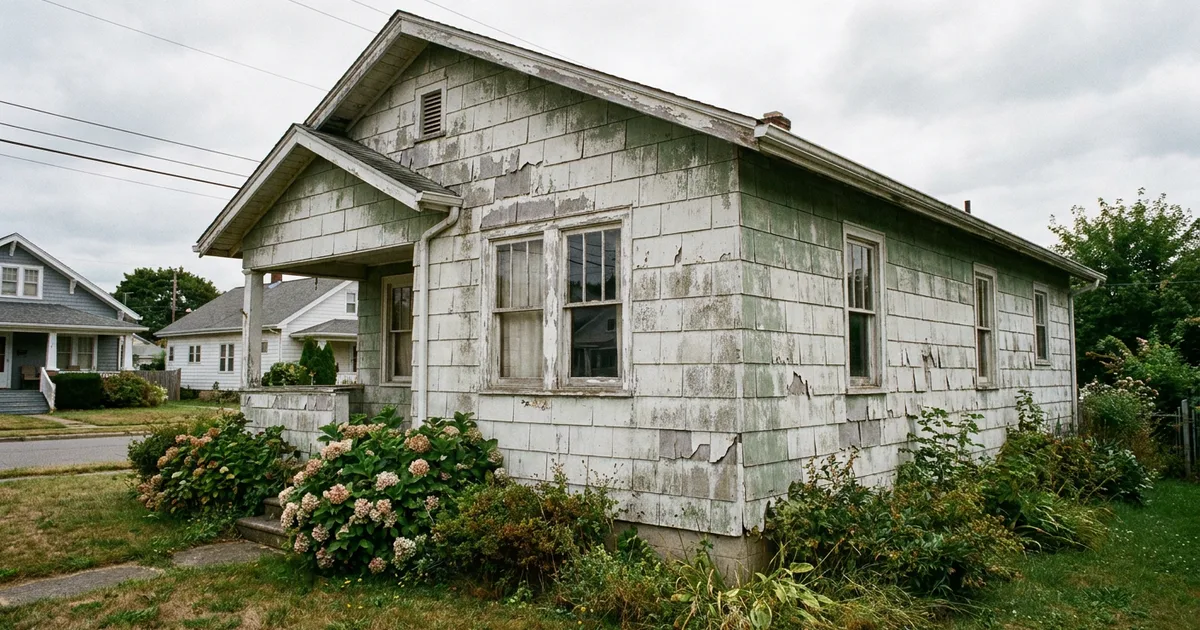
A home inspector just flagged “possible asbestos siding” on your report. Or you were pressure-washing and noticed the wavy-edged shingles under a coat of old paint. Either way, here is the fact that matters most before you do anything else: intact asbestos siding is not an emergency. No federal law requires you to remove it, and left alone, it is considered low-risk by every health agency that has studied it.
The worry is understandable. The word asbestos does a lot of work in people’s heads, and most of it points toward panic. But the cement shingles on your walls have probably sat there for fifty or sixty years without shedding a single fiber into the air you breathe, because undisturbed cement siding does not release fibers the way loose insulation or crumbling pipe lagging does.
This guide answers the three questions you are actually asking, in the order you ask them. Is this asbestos. Is it dangerous right now. And what would it cost to deal with. The only genuinely risky move is taking a sander or a power-washer to it yourself before you know what it is.
Short answer: Cement shingle siding on a home built or re-sided between the 1920s and 1970s is a realistic candidate for asbestos. Intact and painted, it is low-risk and legal to leave in place forever. The one rule that matters is simple: do not cut, sand, drill, or aggressively power-wash it yourself until a lab confirms what it is.
What Is Asbestos Siding (And Why So Many Older Homes Have It)
Asbestos siding is a cement product. Portland cement was reinforced with asbestos fibers and pressed into hard shingle panels, usually 12 inches by 24 inches, then laid in overlapping rows like wood shingles. Builders reached for it because it was cheaper than cedar, fire-resistant, and rot-proof. For its era it was a genuinely useful material, which is exactly why it ended up on such a large share of the country’s older housing.
Johns-Manville trademarked its flagship brand, “Asbestoside,” in 1929. But brand hunting will not help you here. Dozens of regional manufacturers made near-identical panels under their own labels, so there is no single logo or manufacturer’s mark to search for as your main clue. Do not waste time on it.
Installation peaked between 1930 and 1965 and the material stayed on the market into the 1970s before use dropped off sharply. That gives you a practical window: any home built or re-sided roughly between 1920 and 1978 is a realistic candidate. Home age is the single strongest circumstantial signal you have, which is why it does double duty as both context and a first-pass identification test.
Knowing your home’s age narrows the odds. Confirming what is actually on the wall takes a closer look.
How to Identify Asbestos Siding
When people ask what does asbestos siding look like, they want a checklist they can walk outside and run right now. Here is one that actually works, followed by an honest account of where it stops.
Walk the exterior and look for these physical cues together, not in isolation:
- Panel size and layout. Rectangular cement shingles roughly 12 inches by 24 inches, laid in overlapping horizontal rows.
- A wavy or wood-grain bottom edge. Many designs were textured to mimic cedar, so the lower edge looks rippled or grained rather than cut straight.
- A chalky surface. The face feels dry and chalky rather than smooth or plasticky.
- Weight and density. The panels are noticeably heavier and denser than vinyl or modern fiber-cement of the same size.
- Nail pattern. Each panel is typically fastened with two or three visible nails along the bottom.
There is one negative clue with real value. Modern non-asbestos fiber-cement replacements, such as GAF WeatherSide, carry a manufacturer code stamp on the back of the panel. The old asbestos-era shingles generally do not. If you can see the back of a loose or removed panel and it carries a modern stamp, that points away from asbestos.
Now the honest part. None of this is conclusive on its own. Every one of these cues can be present on a panel that turns out to be asbestos-free, and absent on one that is not. The only definitive method is lab testing. A professional pulls a small sample without breaking, sanding, or chipping the panel, then sends it for polarized light microscopy, the industry-standard analysis for solid building materials.
This is where the one rule of the whole piece first shows up, because it falls straight out of “get it tested properly.” Do not create the sample yourself by snapping off a corner or scraping the surface. Disturbing the panel is the single action that turns a low-risk material into an actual hazard, and it is the thing you are trying to test for in the first place. Have someone qualified take the sample.
Say the checklist matches, or a lab confirms it. The next question is the one that actually keeps homeowners up at night: how dangerous is this, right now, today?
Is Asbestos Siding Dangerous? Intact vs. Disturbed
The governing principle is worth stating plainly, because most of the fear around asbestos siding comes from getting it backwards. Risk is exposure-dependent, not presence-dependent. The danger is not that asbestos exists on your wall. The danger is fibers getting into the air and into your lungs, and intact, painted, undamaged siding releases effectively none. The Minnesota Department of Health says as much in its own homeowner guidance: undisturbed siding is low-risk.
So what actually makes it dangerous is a short and specific list. Breaking, sanding, cutting, drilling, sawing, or aggressively power-washing the panels releases fibers. Those are the activities to avoid. There is also a slower path: decades of rain, wind, and freeze-thaw cycling can make old panels brittle enough to crack and spall on their own, even without anyone touching them, which is why a badly weathered wall deserves a closer look than a sound one.
The reason this material feels deceptively safe is buried in the timeline of the diseases it can cause. Inhaled asbestos fibers are linked to asbestosis, which is progressive scarring of the lung, to lung cancer, and to mesothelioma, a cancer of the lining around the lungs or abdomen. None of these show up quickly. Mesothelioma typically has a latency of 20 to 40 years from first exposure, and the CDC has documented cases as long as 71 years out. One analysis of CDC data puts the average at roughly 48 years for men and 53 for women, the gap reflecting men’s heavier historical occupational exposure.
That long fuse is exactly why disturbing the material today feels harmless. Nothing happens in the moment; the consequence, if there is one, arrives decades later. The scale of the numbers matters here, and so does what sits behind them. Across 1999 to 2015, mesothelioma appeared on 45,221 US death certificates, an annual figure that crept from 2,479 to 2,597, and in 2021 the country recorded 1,973 new cases in men and 830 in women (CDC mortality data). Those are the outcomes of decades of mostly occupational, mostly heavy exposure, not of living beside a painted, intact wall. It is a real risk, but a slow-moving and low-probability one that is tied to disturbance, not to proximity.
So intact siding is low-risk and disturbed siding is not, which raises the obvious next question: are you even required to do anything about it?
Do You Have to Remove Asbestos Siding? What the Law Actually Says
The short answer is no, and the reason surprises most homeowners. The EPA never issued a blanket ban on asbestos. It banned specific new uses in stages starting in 1973, then attempted a broad ban under the Toxic Substances Control Act, issued on 12 July 1989 and effective 25 August that year. A 1991 Fifth Circuit Court of Appeals ruling struck down most of it, leaving only narrow bans on a handful of products such as corrugated paper, flooring felt, and genuinely new uses. Old asbestos cement siding was never recalled and never mandated for removal, which is precisely why it is still legally sitting on millions of houses.
The practical rule that follows sits in the EPA’s Asbestos NESHAP, the regulation that governs inspection and notification before renovation or demolition. It explicitly exempts single-family homes and residential buildings with four or fewer units under private ownership. For a normal homeowner, that means the federal pre-work inspection machinery simply does not apply to your house.
The exemption has real limits, and it is worth being precise rather than reassuring here. It does not apply if an owner is demolishing or renovating multiple properties on the same site, or if the residential work is folded into a larger commercial or public redevelopment project. In those cases the full NESHAP rules can come back into play.
There is one more layer. States and municipalities can and do impose their own asbestos handling and disposal rules on the contractors who do the work, on top of anything federal. That is the concrete reason a state-licensed abatement contractor matters more than a general contractor or a handyman. The licensed abatement firm knows the local rule set, holds the credential the state issues, and disposes of the material the way the law requires. A general contractor usually does not.
No legal deadline does not mean no decision to make. If you are renovating, selling, or the siding is already showing damage, you have two real options, and most homeowners do not realize the cheaper one is also the lower-risk one.
Encapsulate or Remove? The Real Decision (and 2026 Costs)
Can you cover asbestos siding instead of removing it? Yes, and for a lot of homes it is the better call. Encapsulation means installing new siding, commonly vinyl, over insulation board directly on top of the existing shingles, with fasteners driven into the wall studs. The asbestos panels stay exactly where they are, undisturbed. There is no abatement crew, no containment, and no disposal fee, because the material is never handled. Municipalities widely endorse this as the lower-risk, lower-cost path whenever the existing siding is still intact.
Full removal is the right choice in a narrower set of cases: the siding is already damaged or friable, a renovation needs to expose the wall assembly, or you simply want it gone before selling. When removal is the answer, it has to be done by a licensed abatement contractor with proper containment, protective equipment, and EPA-compliant disposal. This is not a DIY job and not a general-contractor job. On the register, a firm’s page shows its state license number and issuing agency, so you can see exactly what a verified listing looks like before you call.
The costs below are 2026 figures. Treat them as ranges, not quotes, and be aware the sources do not perfectly agree. Angi puts the national average removal cost near $2,900, while HomeGuide reports an average closer to $3,200 with a wider $708 to $5,696 spread. That disagreement is normal for a job that swings on home size, region, and panel condition, so plan around the range rather than a single headline number.
| Line item | 2026 cost range |
|---|---|
| Pre-project testing and inspection | $300 to $800 |
| Removal, per square foot | $5 to $15 ($8 to $15 on larger jobs) |
| Removal, national average (whole home) | $2,900 to $3,200 (low $1,300, high $5,700) |
| Removal, 2,000 sq ft job | $16,000 to $22,000 |
| Labor, licensed abatement contractor | $75 to $200 per hour |
| Containment and site prep | $500 to $2,000 |
| EPA-compliant disposal | $10 to $50 per cubic yard |
| Encapsulation (new siding over), 2,500 sq ft home | $4,000 to $20,000 |
So the decision usually makes itself: if the wall is intact, encapsulation reaches the same practical result, no airborne fibers, for less money, because the panels are never handled. Removal is the correct spend only when the material is already failing or is in the way of other work. Neither is a scam and neither is the automatic answer. Which one fits depends on the condition of your siding and what you plan to do with the wall, not on which one a contractor would rather sell you.
Whichever path fits your situation, the one step that matters more than either price is who you hire to do it.
What to Do Next
Start by not undoing the good position you are already in. While you are still deciding, do not sand, cut, drill, or power-wash the siding. Intact is safe, disturbed is not, and there is no deadline forcing your hand.
The first real step is a professional inspection and lab test to confirm what you actually have. If the result calls for action, the person you want is a state-licensed asbestos abatement contractor, not a general contractor and not a handyman, because only the licensed firm carries the credential and the disposal obligations the law attaches to this work.
This is where most “find a contractor” results let you down. Angi, HomeAdvisor, and the generic directories are not checking whether a firm’s asbestos license is current, or whether it holds one at all. They sell leads. A five-star rating is not a license. The Asbestos Register exists to close exactly that gap: every firm is verified against its issuing state’s official licensing register, with the license number and agency shown alongside it, so you can confirm the one credential that matters before you call anyone. If you are in a high-demand state you can start at your state hub, such as California or New York, and search from there.