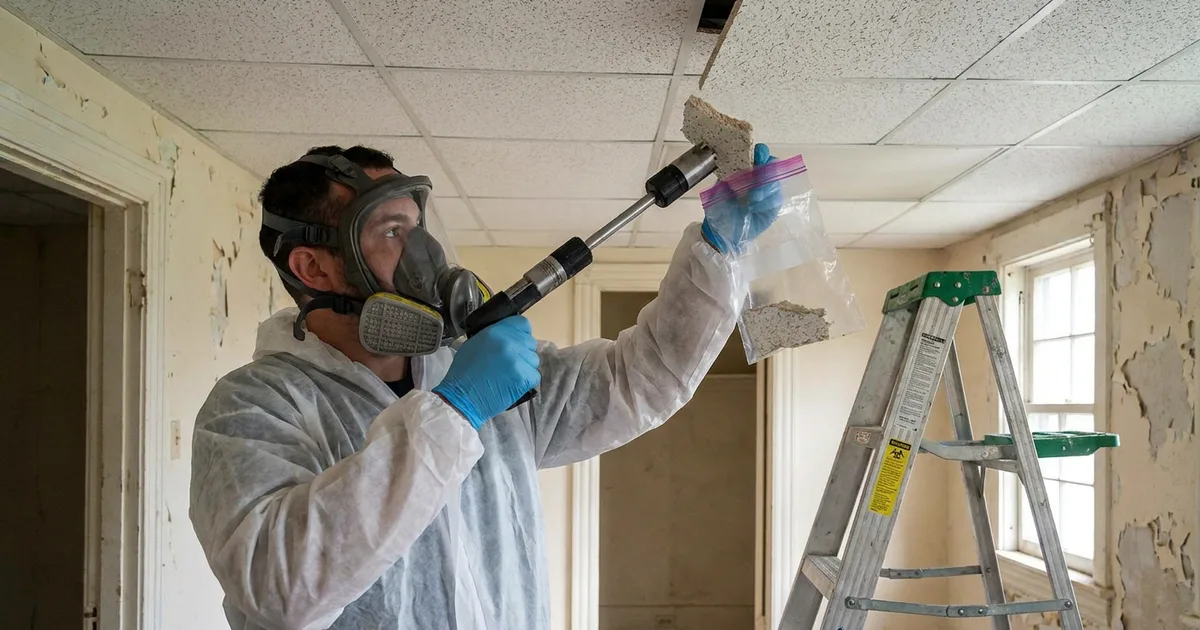
A $40 asbestos test kit and a $500 professional inspection can produce the exact same piece of paper: a lab result that says yes or no. The difference is whether anyone else will accept that paper as proof, whether that’s a buyer’s agent, an insurer, or a building inspector.
Almost half of US homes were built before 1980, the peak of the asbestos era, according to the U.S. Census 2019 American Community Survey. So if you own an older home and you’re planning a renovation, buying, selling, or staring at a cracked popcorn ceiling, an asbestos test is usually the sensible first move.
But cost is the wrong first filter. The real question is legitimacy. A cheap kit and an unlicensed “inspector” both hand you a result, yet that result only means something if the lab was accredited and the person who took the sample was qualified to take it. This guide walks both routes, the honest all-in costs, and the one verification step almost no competing guide bothers to explain.
Short answer: A DIY asbestos test kit costs $30 to $80 per sample, closer to $100 once you add shipping and lab fees. A professional inspection averages $483. Use a kit only for intact, non-friable material where your state allows self-sampling. For a home sale, insurance claim, or permit, hire a state-licensed inspector.
Do You Actually Need an Asbestos Test?
Not every old material needs a lab report tomorrow. The EPA estimates more than 30 million tons of asbestos went into American construction between 1900 and 1980, so in a pre-1980 home the odds aren’t trivial. But asbestos that’s intact, sealed, and left undisturbed generally isn’t an active hazard. The agency’s guidance is to leave sound material in place rather than go looking for trouble. Fibers become dangerous when material is cut, sanded, drilled, or demolished, which is exactly when they go airborne.
So before you ask how to test for asbestos, ask whether you need to. You do when the material is damaged or deteriorating, or when you’re about to disturb it. The clearest triggers are a pre-1980 home purchase, a planned flooring or ceiling renovation, visible damage to suspect material, or a real estate sale where disclosure is on the table.
There’s one thing people consistently get wrong. You can’t tell asbestos-containing material apart from ordinary material by looking at it. An asbestos floor tile and a modern one can be identical to the eye. Lab analysis is the only reliable way to get a yes or no, which is why both DIY kits and professionals exist in the first place. The choice between them is what the rest of this guide is about.
DIY Asbestos Test Kits: What They Actually Cost
A mail-in asbestos test kit is marketed at $30 to $80 per sample. That headline number is real, and it’s also incomplete. The advertised price usually excludes shipping and the lab analysis fee, and rush processing can push the true all-in cost of a “$40” kit closer to $100. Once your sample reaches the lab, standard polarized light microscopy (PLM) analysis runs about $35 to $50 per sample with a turnaround of roughly five business days.
The kit itself is the easy part. Collecting the sample safely isn’t. The real DIY process looks like this:
- Put on an N95 or P100 respirator, not a paper dust mask.
- Wet the suspect material with water and a little detergent to suppress fiber release.
- Cut a small sample with a wet knife, working slowly.
- Double-bag it, seal it, and label it clearly.
- Wipe the area down with damp paper towels, then bag those too.
That’s careful, deliberate work. The kit marketing skips past the real hazard: cutting into a popcorn ceiling or lifting a floor tile is the single moment fibers are most likely to go airborne. The DIY process itself carries the exact exposure risk it’s meant to rule out. That’s why the EPA and CDC both steer homeowners toward professionals rather than kits.
There’s a legal catch too. Some states restrict homeowners from collecting their own asbestos samples and require a licensed professional to do it. That’s a genuine dealbreaker. Before you order a kit, check whether your state even permits self-sampling. Some, Texas among them, require a licensed professional to pull the sample, which takes DIY off the table entirely. A DIY kit is only defensible for non-friable material in good condition. For anything damaged, friable, or crumbling, do NOT touch it yourself.
Professional Asbestos Testing: What You’re Paying For
A professional asbestos test costs more because it bundles more. The national average for a professional inspection is $483, with a typical range of $231 to $776 according to Angi’s 2026 cost data, and broader estimates put it anywhere from $200 to $800 depending on the size of your home and how many samples are pulled.
What actually drives the price is the testing method. Breaking it down plainly:
| Testing method | Typical cost | When it is used |
|---|---|---|
| Bulk / physical sample | $250 to $750 | The most common method; a piece of the suspect material is analyzed by PLM |
| Air sample | ~$500 (range $200 to $800) | Measures airborne fibers, often after disturbance or during clearance |
| Dust sample | $120 to $180 incl. labor | Cheapest option; checks settled dust on surfaces |
For smaller jobs, a visit with a few samples and a written report bundled together typically runs $300 to $700. So “professional” doesn’t automatically mean the top of the range. If you assumed hiring a pro meant $800 minimum, a modest inspection is often cheaper than you feared.
What you’re paying for is everything a kit can’t give you. A licensed inspector performs a visual survey, collects multiple samples following a documented protocol for statistical confidence, works only with an accredited lab, and issues a written report that carries legal weight for real estate, insurance, and permitting. That written report is what you’re really buying, and it’s only worth anything if the firm behind it is genuinely licensed. Whether you’re comparing inspectors in New York or anywhere else, the report’s value rests entirely on the credentials of the firm that produced it.
DIY vs Professional Asbestos Test: The Decision Framework
Every cost guide gives you a price. Almost none give you a decision. Here’s the comparison the top search results are missing, and the columns that matter most aren’t cost, they’re safety and legal validity.
| Factor | DIY test kit | Licensed professional |
|---|---|---|
| Cost | $30 to $80 per sample (~$100 all-in with shipping and lab) | $200 to $800 total; national average $483 |
| Safety during sampling | You disturb the material yourself, the highest-risk moment | Containment, protective gear, and trained handling |
| Legal / real estate validity | Often not accepted for sales, insurance, or permits on its own | Written report with standing for transactions and permitting |
| Turnaround | ~5 business days once the lab receives it | Similar lab time, plus a scheduled site visit |
| State restrictions | Some states bar homeowner self-sampling entirely | Licensed to sample in the states where it is required |
My opinion, and it’s the same one the EPA and CDC hold: DIY is defensible only when three things are all true. The material is intact and non-friable, your state permits homeowner sampling, and you don’t need the result for a sale, a claim, or a permit. If any one of those fails, hire a licensed pro. For anything that carries real consequences, professional testing is the sensible default.
One more thing, about what the result itself means. A material is only classed as regulated asbestos-containing material once lab analysis shows more than 1% asbestos content under EPA and OSHA standards. Below that, it isn’t regulated ACM. That threshold is why the analysis, and the lab doing it, matters more than the sampling method you chose.
How to Verify a Lab and an Inspector Are Legitimate
This is the step no competing guide walks you through, and it’s the whole reason a test result is worth anything.
Start with the lab. NIST runs the National Voluntary Laboratory Accreditation Program (NVLAP), which accredits labs to analyze asbestos by PLM and TEM, backed by mandatory proficiency testing. Under NIST’s program, that accreditation is legally required for any school-related sample under the 1986 Asbestos Hazard Emergency Response Act (AHERA). It isn’t federally mandated for private homes, but it’s the strongest best-practice signal you can look for, and NIST keeps a public online directory of NVLAP-accredited labs. Check it before you mail a DIY sample or accept a contractor’s “in-house lab.” The EPA’s own guidance on identifying asbestos in the home reinforces the same point.
The inspector side is harder. There’s no single national asbestos license. Inspector and abatement contractor licensing is administered state by state. In California, for instance, you’d confirm a firm against California’s own program; in Pennsylvania, against the Department of Labor and Industry. That fragmentation is the problem. When you search “asbestos testing near me,” the results include companies with no easy way to confirm they’re actually licensed in your specific state. A five-star Google rating is not a license.
This is the exact gap The Asbestos Register was built to close. Every firm listed is checked against its state’s official licensing register, with the license number and issuing agency shown alongside it. You get the verification step done for you, before you hand anyone your details.
Materials That Actually Warrant Testing
If you’re pointing a tester at something, these are the usual suspects in a pre-1980 home:
- Vinyl floor tiles and the mastic adhesive underneath them
- Popcorn and textured ceilings
- Pipe and duct insulation
- Wallboard joint compound
- Vermiculite attic insulation
- Cement-based exterior siding
- Roofing felt and shingles
Finding one of these doesn’t mean you need to rip it out. Intact, undisturbed material can generally stay where it is. Removal decisions follow disturbance risk, whether the material is damaged, deteriorating, or in the path of a planned renovation. So test what you’re about to disturb, and don’t go hunting for problems in material that’s sound.
Once you know what to test and how to confirm who’s doing the testing, the last step is finding someone genuinely credentialed in your state.