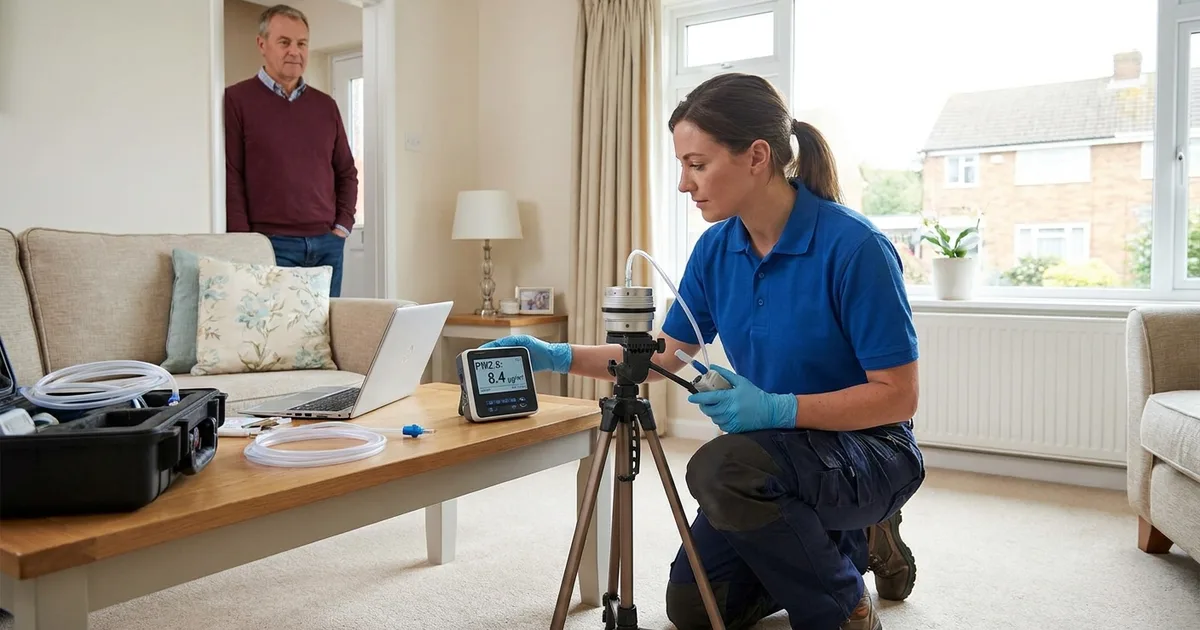
The air inside your home can carry pollutant concentrations 2 to 5 times higher than the air outside, and in some cases up to 100 times higher, according to the EPA. Americans spend about 90 percent of their time indoors, so that gap matters more to your actual exposure than most outdoor air-quality headlines ever will.
But most homeowners never realize this: you can book a standard indoor air quality test, get a clean report, and still walk away with no answer on the pollutant that carries the highest long-term health stakes of the lot. Asbestos is a known carcinogen linked to lung cancer and mesothelioma, and it is the one pollutant a standard test most often leaves out.
Indoor air quality services are not one standardized package. Different providers test for different pollutants, price them differently, and, crucially, treat asbestos as a separate job with a separate license. This guide breaks down exactly what gets tested, what each test measures, what it costs in 2026, and the specific triggers that tell you which test you actually need.
Short answer: A generic whole-home indoor air quality test usually covers mold, VOCs, radon, and allergens, but it does not automatically test for asbestos. If your home was built before 1980 or you are about to renovate, you have to request asbestos testing by name, because it uses a different sampling method, a different threshold, and a state-licensed inspector.
Why Indoor Air Quality Testing Exists in the First Place
Modern homes are sealed tightly for energy efficiency. That is good for your heating bill and bad for your air. Combustion byproducts, off-gassing from building materials, and moisture-driven biological growth all get trapped indoors instead of dissipating outside the way they would in a draftier old house.
That trapping effect is why indoor pollutant levels regularly run higher than outdoor levels, sometimes dramatically. The air your building holds in is the air you breathe for most of the day.
This is not a hypothetical risk category. Radon alone, a naturally occurring gas that seeps up from the soil, is the second leading cause of lung cancer in the United States. The EPA's best estimate puts radon behind roughly 21,000 lung cancer deaths a year, with an uncertainty range of 8,000 to 45,000. Twenty-one thousand deaths a year is not a rounding error, and radon is only one of six things a test can look for. The rest of the list is where it gets more complicated.
The Six Pollutants Indoor Air Quality Services Actually Test For
Most service pages give you a vague list and a booking button. Here is the version with the thresholds behind it, pollutant by pollutant, because the numbers are what tell you whether a reading is a problem.
Asbestos. Found in insulation, floor tile, popcorn ceilings, siding, and pipe wrap throughout pre-1980 construction. Testing is done two ways: bulk sampling of suspect material sent to a lab for PLM or TEM analysis, or air sampling measured against a safety threshold of 0.01 fibers per cubic centimeter (f/cc). This is the pollutant that behaves nothing like the other five, for reasons covered in the next section.
Mold. Measured by spore-count air sampling, surface sampling, or tape sampling. There is no single federal numeric standard for mold, so results are judged against the outdoor baseline spore count and the species present. A count that reads high indoors relative to the air outside your door is the flag.
VOCs (volatile organic compounds). Paint, new furniture, cleaning products, and fresh flooring off-gas these into the air, where they are measured in parts per billion or parts per million against reference guideline levels. A newly renovated room with a chemical smell is the classic VOC scenario.
Radon. A radioactive gas that seeps from soil and rock through foundation cracks. It is measured in picocuries per liter (pCi/L). The EPA action level is 4 pCi/L, at which a fix is recommended, with mitigation worth considering between 2 and 4 pCi/L. For scale, the average US indoor level is about 1.3 pCi/L, and roughly 1 in 15 US homes is estimated to have elevated radon.
Carbon monoxide. Furnaces, water heaters, fireplaces, and attached garages all produce it, and a CO monitor measures it directly. This is the fast-acting one, dangerous in the short term rather than over decades.
Particulates and allergens. A catch-all that can include dust, fiberglass, formaldehyde, bacterial endotoxins, and tobacco residue, alongside temperature and relative humidity. Humidity earns its place on the list because it drives mold risk, so a comprehensive assessment measures it too.
Of that list, one pollutant behaves nothing like the rest, and it is the one most bundled tests quietly skip.
The Pollutant Most Bundled IAQ Tests Skip: Asbestos
The generic whole-home bundle you see advertised on indoor air quality company websites usually means mold, VOCs, allergens, and sometimes radon. Asbestos is frequently not in that package. It is priced and scheduled as a separate, dedicated inspection, and plenty of homeowners never learn that until it is too late to matter.
There are two reasons for the split. The first is method. Everything in the general bundle is sampled one way, while asbestos requires either bulk material sampling for lab analysis or air sampling against the 0.01 f/cc threshold. The second is credentials. Asbestos inspectors are licensed at the state level, a qualification distinct from the general indoor air quality technician who runs your mold and VOC readings. One person is often not licensed to do both.
No federal law requires a US homeowner to test for asbestos before renovation. That surprises people, and it gets misread as permission to skip it. State and local building and renovation codes can still apply, so "nobody is making me" is not the same as "there is no risk here." Testing runs $250 to $850, which is a small price against the alternative.
And the alternative is the point. Asbestos is the one pollutant on the list where getting the sampling wrong has direct health consequences, not just a bad reading on a report. Improperly disturbing asbestos-containing material releases fibers linked to lung cancer and mesothelioma. A botched mold sample gives you bad data. A botched asbestos sample can put fibers in your air. That single difference is why asbestos earns its own inspection, its own license, and its own line on the quote.
When You Actually Need an Indoor Air Quality Test
You do not need to test your air on a schedule. You need to test it when something specific triggers it. Here are the triggers worth acting on.
Symptoms with no other explanation. Musty odors that will not clear, unexplained coughing or sneezing, eye or throat irritation, or headaches and fatigue that track with time spent at home. When people feel better after leaving the house, the house is a suspect.
Water damage. Recent flooding, a slow leak, visible mold growth, or humidity that stays high no matter what you do. Moisture is the single biggest driver of biological growth indoors, so any water event is a reason to check.
A real-estate transaction. Before buying or selling, a test documents conditions that a standard home inspection is not designed to catch. It protects the buyer from inheriting a problem and the seller from a surprise late in the deal.
Age and renovation, the asbestos-specific trigger. Before any renovation or demolition in a home built before 1980, you need an asbestos inspection specifically, not the general bundle. Disturbing old insulation, floor tile, ceiling texture, or drywall can release fibers, and pre-1980 construction is where those materials live. This is the case where a dedicated, licensed asbestos inspection is the right call, and if a test confirms a problem, the next step is finding a licensed firm for asbestos removal near you.
An HVAC change. After a new system goes in or a major combustion appliance is installed, testing confirms the change did not introduce a new problem into your air.
Any one of these five is reason enough to test. What that testing looks like, and where the do-it-yourself version falls apart, is the next thing to get right.
How Professional Testing Works, and Why DIY Kits Fall Short for Asbestos
A professional indoor air quality visit follows a consistent shape. It starts with a walkthrough inspection to identify likely pollution sources and the best places to sample. Then comes the sampling itself, either instrument-based air collection, physical or bulk material collection, or both. Those samples go to a certified lab, and you get back a written report comparing your results to the relevant thresholds. Some providers also assess HVAC performance while they are there.
DIY consumer kits do exist, and for some pollutants they are legitimate. Radon screening is the clearest example, where EPA-accepted consumer test kits give you a reasonable first read for very little money. Mold kits exist too, but they are a weaker buy: a home kit can confirm spores are present without telling you whether the count is a genuine health problem or just the normal outdoor baseline drifting in through an open window.
Asbestos is where the DIY route stops being an option. Consumer asbestos kits are explicitly not recommended, for two reasons that both matter. Collecting a sample of suspect material can disturb it and release fibers, which is the exact hazard you were trying to measure. And results from uncertified sampling are not accepted for any regulatory or legal purpose, so a DIY positive gets you nothing you can act on formally. This is the pollutant where you pay a licensed professional or you do not test at all.
What Indoor Air Quality Testing Costs in 2026
Pricing is the one thing the cost-guide articles do well, so here are the current numbers, drawn from Angi's 2026 data. Use them to sanity-check any quote you receive.
| Service | Typical cost (2026) |
|---|---|
| Whole-home IAQ test | Average $443, typical range $303–$616, overall spread $150–$1,000 |
| Mold testing | $300–$1,000, commonly around $700 |
| Asbestos testing | $250–$850 for a standard single-family home; physical sample tests $250–$750 |
| VOC testing | $200–$300 per sample |
| Bundled package (mold + VOCs + radon + allergens) | $400–$800 |
Those ranges swing on three things: home size, location, and how many pollutants you actually test for. The line to watch is the bundled package of mold, VOCs, radon, and allergens at $400 to $800, because that is the number most homeowners anchor to and it almost never includes asbestos.
So if you are budgeting for a pre-1980 home, add asbestos as its own line rather than assuming the $400 to $800 already covers it. The price is the easy part. The harder call is who you hire.
How to Choose an Indoor Air Quality Tester (and When to Go Straight to an Asbestos Specialist)
For the general bundle of mold, VOCs, radon, and allergens, look for a certified industrial hygienist or an environmental consultant who backs the visit with lab reporting. An instrument reading called out on the spot is not the same as a certified lab result you can hold onto. The report is what you are paying for.
For asbestos, do not default to whoever runs your general air quality inspection. Confirm they hold a current state asbestos inspector or abatement license, which is regulated separately from general IAQ technician certification. Assuming the person testing your mold is also cleared to test your asbestos is the single most common way homeowners get this wrong.
If your home is pre-1980 or you are planning a renovation, book the asbestos inspection as its own line item. Do not assume it is bundled in, and do not accept a quote that lists "indoor air quality testing" without naming asbestos explicitly. If asbestos is not on the paper, it is probably not in the test.
Verifying a state asbestos license yourself is harder than it should be, because every state runs its own register and there is no national list. That is exactly the gap this directory closes. Every firm is cross-checked against its issuing state's official register before it goes live, with the license number on record. In California, which has the largest pool of licensed contractors in our data, you can see at a glance who is actually cleared to do the work, and you can search a dedicated asbestos testing directory the same way in any covered state.
So the takeaway is one concrete action. Look at your indoor air quality quote and check whether the word "asbestos" appears on it. If it does not, and your home is pre-1980 or renovation-bound, you do not have full coverage. You need a separate, state-licensed asbestos inspection, verified before you hire, not a general bundle you assumed would catch everything.