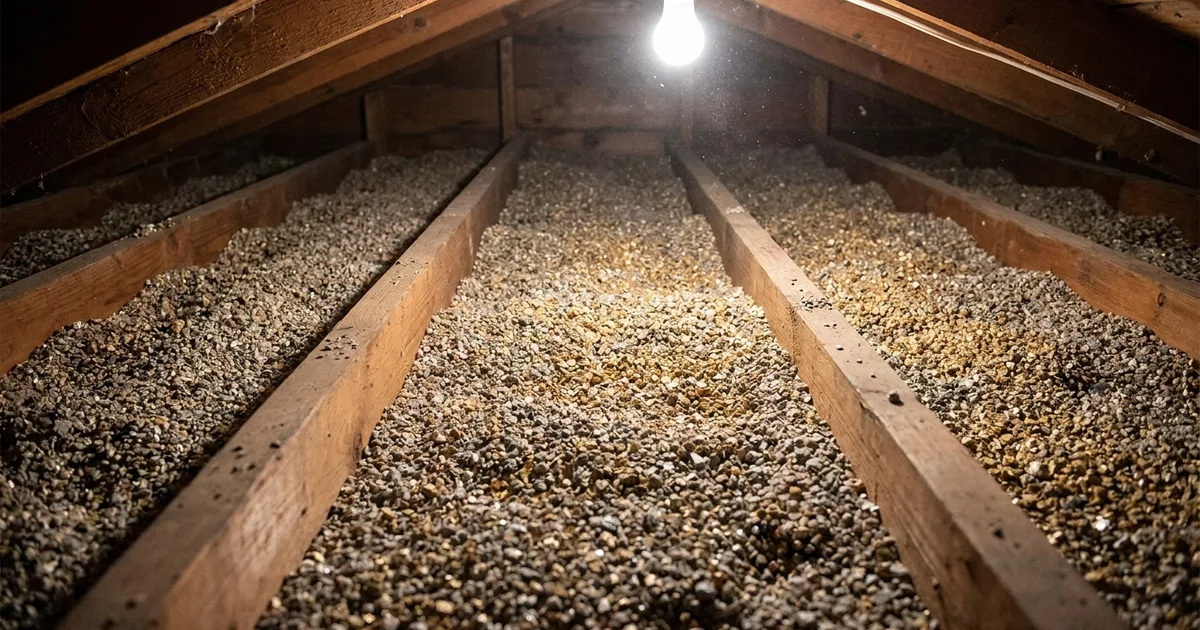
If the insulation in your attic is loose, shiny, and pours out like small gray-gold pebbles, you are almost certainly looking at vermiculite insulation, and you are right to check what it is before you touch it. More than 70% of all vermiculite sold in the US between 1919 and 1990 came from one mine in Libby, Montana, where the ore was naturally contaminated with asbestos.
What almost nobody tells you is that a legal settlement trust exists specifically to pay homeowners back for dealing with it, up to $4,125 per claim. That is the piece the EPA page and the contractor blogs leave out, and it changes the math on this whole problem.
You are not overreacting by looking this up. But finding vermiculite insulation is not an emergency either. It is a three-step process: do not disturb it, test it, and hire a licensed pro only if the test comes back positive. Here is the ordered version of what to actually do, including the money most people never claim and how to make sure the contractor you hire is real.
Short answer: Loose, pebble-like attic insulation is almost certainly vermiculite, and most of it installed before the 1990s should be assumed to contain asbestos until a lab test says otherwise. Intact and undisturbed, it is low-risk. If you need it removed, a licensed contractor is the only legal route, and the Zonolite Attic Insulation Trust can reimburse up to 55% of the cost.
What Vermiculite Insulation Actually Looks Like
Vermiculite insulation is a loose-fill material made of small, pebble-sized granules, roughly the size of a pencil eraser or smaller. It was poured between attic joists, and occasionally blown into wall cavities, rather than laid in batts like fiberglass. If you can run your hand through it and it moves like gravel, that is the loose-fill giveaway.
The color runs from light-brown or gray-brown to a silvery, almost golden sheen. The defining trait, the one that separates it from cellulose or fiberglass at a glance, is the texture. Each granule has a shiny, mica-like, accordion-layered look that catches the light. Cellulose looks like shredded gray paper and fiberglass looks like spun cotton candy. Vermiculite looks like tiny flakes of mineral.
Most vermiculite insulation sold in the US carried the brand name Zonolite, made by W.R. Grace and Company, and it was on the market from the 1940s through the 1990s. If your home is from that era and the attic is filled with loose gray-gold granules, Zonolite insulation is the most likely answer.
The reason it is so light is that raw vermiculite expands 8 to 30 times its original size when it is heat-processed. That expansion is what makes it a good, fire-resistant insulator, and it is also why a whole attic of it weighs so little.
Why Vermiculite Insulation Is Linked to Asbestos
The health concern is not vermiculite itself. It is what came out of the ground with it. A single mine near Libby, Montana supplied more than 70% of all vermiculite sold in the US between 1919 and 1990, and that deposit was naturally intermixed with a form of asbestos related to tremolite and actinolite. The asbestos was not added. It was a geological contaminant baked into the ore.
Because Libby-sourced material dominated the market, and because Zonolite was the dominant consumer brand built on that supply, health authorities now take a blunt position. The EPA and state health departments advise homeowners to treat any vermiculite insulation installed before the 1990s as if it contains asbestos unless a lab has proven otherwise. This is the vermiculite asbestos link in plain terms: not every batch was contaminated, but so much of the supply came from one bad source that assuming the worst is the only safe default.
Here is the part that trips people up. You cannot tell contaminated vermiculite from clean vermiculite by looking at it. Neither can a trained inspector, at least not by eye. The asbestos fibers are microscopic, and they are mixed unevenly through the material. Lab analysis, usually polarized light microscopy, is the only reliable way to know. The USGS reported a faster field-screening tool in 2018, but standard practice has not changed: assume contamination, then send a sample to an accredited lab.
Is Vermiculite Insulation Actually Dangerous?
Asbestos is dangerous when its fibers become airborne and someone breathes them in. That is the one fact the EPA, state health departments, and home inspector associations all repeat. Fibers sitting locked inside a material are not the same threat as fibers floating in the air of a room you are standing in.
This matters enormously for how you should feel about what you found. Intact vermiculite sitting undisturbed in an attic carries meaningfully lower risk than the same material after someone has swept it, vacuumed it, or stirred it up during a renovation. The danger is not really in having it. The danger is in disturbing it.
So the goal is not to rush the material out of your house. It is to leave it alone, find out what it actually is, and act only if the answer forces your hand. The next three sections turn that into a specific sequence.
Step 1: Do Not Disturb It
Before you test anything, before you call anyone, the rule is simple: leave it alone. The EPA and university extension programs are unanimous on this, and disturbing the material before confirming what it is remains the single most common mistake homeowners make.
- Do not sweep, vacuum, or handle the granules directly. All three send fibers into the air.
- Do not stack boxes, holiday decorations, or storage bins on top of it. Weight compresses and disturbs the material, and every time you move those boxes you disturb it again.
- Do not let children play or store things in an attic where it is present.
- Do not attempt DIY removal under any circumstances. This is called out explicitly by the EPA and by university extension guidance, and it is where homeowners turn a low-risk situation into an airborne-fiber problem.
Once the material is genuinely left alone, the only way to know what you are dealing with is a lab test. Here is what that involves and what it costs.
Step 2: Get It Tested
Testing is a controlled, professional process, not a DIY chip like you might do with floor tile. A certified inspector takes a small sample using sampling protocols designed specifically to avoid disturbing the bulk material, then sends it to an accredited lab for polarized light microscopy analysis. The lab confirms whether asbestos is present and roughly how much.
Costs are all over the map because "asbestos test" covers everything from a single sample to a full home survey. Reported prices range from about $100 to $2,000. For a standard residential vermiculite test, most homeowners should expect to land somewhere in the $250 to $850 range.
A few hundred dollars settles the question either way. It stops you from panicking into a removal you did not need, and from ignoring a hazard you did. That is a small price to close out the guesswork. To find a certified inspector near you, start with our asbestos testing directory, where every firm is checked against its state license.
If the test comes back clean, you are done. If it comes back positive, the process shifts from wait-and-see to hiring a licensed professional, and both the cost and the legal requirements step up.
Step 3: If It's Positive, Hire a Licensed Abatement Contractor
A positive result closes off the DIY option for good. Contaminated vermiculite has to be removed by a licensed abatement contractor using HEPA vacuum extraction under sealed, negative-air containment. That is the only legal method for vermiculite insulation removal. A handyman with a shop vac is not a legal or safe substitute, and hiring one is how fibers end up in your living space.
Cost depends heavily on attic size and region. Reported figures run from around $2,000 at the low end to $15,000 for large jobs, with $7,000 to $12,000 commonly cited as a typical range. On a per-square-foot basis, removal under proper containment runs roughly $5 to $15 per square foot. Use those numbers to sanity-check any quote you receive.
| Item | Typical figure |
|---|---|
| Testing (standard residential) | $250 to $850 |
| Full removal (typical range) | $7,000 to $12,000 |
| Full removal (per square foot) | $5 to $15 |
| Zonolite Trust reimbursement | Up to 55%, capped at $4,125 |
One threshold gets quoted a lot and deserves a caveat. Some contractors will work around vermiculite that tests below 1% asbestos content, taking precautions rather than doing a full strip-out, while material above that level is generally required to be fully removed before renovation proceeds. Treat the 1% figure as a common industry practice rather than a single blanket law, and confirm what your state and your specific contractor require. For a licensed firm in your area, our asbestos removal directory lists contractors verified against their state register.
Before you assume that $7,000 to $12,000 bill comes entirely out of your pocket, there is a reimbursement program almost nobody searching this topic knows exists.
The Zonolite Attic Insulation Trust: Money Most Homeowners Never Claim
When W.R. Grace and Company went through bankruptcy reorganization, finalized on February 3, 2014, part of the settlement created a trust for exactly this situation. The Zonolite Attic Insulation Trust exists to reimburse eligible homeowners for a portion of the cost of removing Zonolite insulation from their homes.
The numbers are concrete. Eligible claimants can recover up to 55% of their abatement cost, capped at $4,125 per claim. On a $10,000 removal, that is the difference between paying the whole thing and getting a few thousand dollars back for work you had to do anyway.
This is not a defunct or symbolic program. The trust is funded for a minimum of 20 years from the 2014 settlement date, and it has paid out roughly $14 million in claims since it started. It is active, funded, and processing claims right now, which is precisely why it is worth knowing about before you sign a removal contract.
The practical steps are straightforward. You file directly through the trust's official claim form, and you do it after abatement is complete, so keep every contractor invoice as documentation. The official details live on the Zonolite Attic Insulation Trust site. Filing the claim assumes one thing, though: that you hired a legitimate, licensed contractor in the first place. That is where a lot of homeowners get exposed.
How to Verify Your Contractor Is Actually Licensed (Not Just Reviewed)
A five-star rating on Yelp, Angi, or Google tells you a company shows up on time and is pleasant to deal with. It tells you nothing about whether that company holds an active state asbestos license. Those platforms take listings and display reviews. They do not verify licensing, and they never claim to.
This matters more with asbestos than almost any other home job, because asbestos licensing in the US is handled state by state. There is no single national register you can search. To confirm a contractor is actually licensed, you have to know which state agency issues the license and then find its list, which is often a clunky .gov PDF buried several clicks deep.
That is the gap The Asbestos Register is built to close. Every firm listed is cross-checked against its issuing state's official licensing register before it goes live, with the license number shown alongside it. In New York, for example, you can see at a glance which contractors are actually cleared to do the work, instead of guessing from star ratings. It is the verification step that should come before you hand anyone a removal contract, done for you instead of left as homework.
So the whole thing comes down to a short, ordered plan. Leave the material alone, get it tested for a few hundred dollars, and if it is positive, hire a state-licensed abatement contractor and claim your reimbursement from the Zonolite Trust. Finding vermiculite in your attic was never the emergency. Disturbing it, or trusting the wrong person to remove it, is the only part that actually hurts you.